Scale factor worksheet for geometry students helps learners understand how shapes change size while keeping their proportions the same. This concept is essential when working with similar figures, maps, blueprints, and models. Whether you're solving math problems or trying to figure out real-world measurements, knowing how to calculate and apply a scale factor makes a big difference.
Students often use scale factor worksheets to practice identifying how one shape relates to another in terms of size. For example, if a rectangle is twice as long and twice as wide as another, the scale factor between them is 2. Understanding this relationship helps with tasks like enlarging or reducing images, calculating distances on maps, or building scale models.
What is a scale factor?
A scale factor is a number that describes how much a shape is stretched or shrunk compared to another similar shape. It’s calculated by dividing the length of a side in one figure by the corresponding side in the other. If the result is greater than 1, the shape is larger. If it’s less than 1, the shape is smaller.
For instance, if a triangle has sides measuring 3 cm, 4 cm, and 5 cm, and another triangle has sides measuring 6 cm, 8 cm, and 10 cm, the scale factor from the first to the second is 2. This means the second triangle is twice as big as the first.
When do students use scale factor worksheets?
Scale factor worksheets are commonly used in geometry classes when students study similar figures, transformations, and proportional reasoning. Teachers often assign these worksheets to reinforce classroom lessons and help students apply concepts in different contexts.
Students might also use scale factor worksheets when working on projects involving architecture, engineering, or design. These activities require precise measurements and adjustments based on scale, making the skill practical beyond the classroom.
Common mistakes to avoid
One common mistake is confusing the direction of the scale factor. For example, if a shape is reduced, the scale factor should be less than 1, not greater. Another error is using the wrong pair of sides when calculating the scale factor. Always match corresponding sides in similar shapes.
Some students also forget to check whether the scale factor applies to all dimensions of a shape. A consistent scale factor must be used for length, width, and height in three-dimensional objects. If one dimension changes differently, the shapes aren’t similar.
Useful tips for working with scale factors
Start by identifying which shape is the original and which is the scaled version. This helps determine whether the scale factor is an enlargement or reduction. Use a calculator to divide corresponding side lengths, and double-check your results.
Practice with diagrams and real-life examples can make the concept more concrete. For instance, comparing a map to actual distances or analyzing a model car’s proportions can help visualize how scale factors work. Learn more about understanding scale factor in math problems.
Real-world applications of scale factors
Scale factors are used in many areas outside of math class. Architects use them to create blueprints that represent buildings at a smaller size. Engineers rely on scale factors when designing prototypes or testing structures. Artists and designers also use scale factors to adjust the size of their work for different formats.
Even everyday tasks, like reading a map or following a recipe, involve some form of scaling. A map scale might show that 1 inch equals 10 miles, which is a scale factor of 10. In cooking, doubling a recipe requires applying a scale factor of 2 to each ingredient measurement.
Next steps for geometry students
If you’re just starting to learn about scale factors, begin by practicing with simple shapes and clear examples. Use worksheets that include diagrams and measurements to build confidence. As you become more comfortable, try applying scale factors to real-world situations, such as creating a scale drawing of a room or adjusting a photo’s size.
Explore additional resources to deepen your understanding. See how scale factors appear in real-world examples. You can also look for ways to calculate scale factors from diagrams and measurements, as covered in this guide.
Keep asking questions and seeking clarification when needed. Geometry becomes easier with practice and patience. Don’t hesitate to review previous lessons or ask for help if you feel stuck.
Checklist: - Identify corresponding sides in similar shapes - Calculate the scale factor by dividing lengths - Check that the scale factor is consistent across all dimensions - Practice with diagrams and real-life examples - Review common mistakes and how to avoid them
 Interpreting Scale Factor in Real World Examples
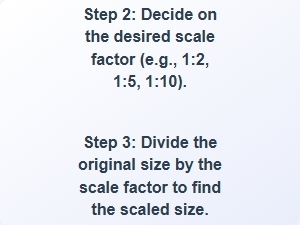 How to Calculate Scale Factor Step by Step
 Understanding Scale Factor in Math Problems
 Determining Scale Factor From Diagrams and Measurements
 Scale Factor Examples for Students
 Scale Factor Worksheet Problems in Geometry