Understanding how to determine scale factor from diagrams and measurements is essential for anyone working with geometry, architecture, or design. Whether you're creating blueprints, analyzing maps, or solving math problems, knowing the scale factor helps you accurately translate between real-world dimensions and scaled representations.
The scale factor is a number that shows how much a shape has been enlarged or reduced compared to its original size. For example, if a drawing of a car is twice as big as the actual car, the scale factor is 2. If it's half the size, the scale factor is 0.5. This ratio lets you calculate missing measurements or compare different versions of the same object.
When and Why You Need to Determine Scale Factor
You might need to find the scale factor when working with maps, models, or technical drawings. Architects use it to create detailed building plans. Engineers rely on it to ensure parts fit together correctly. Students often encounter it in geometry classes when learning about similar figures and proportional relationships.
Imagine you have a map where 1 inch equals 10 miles. To find the scale factor, you convert both measurements to the same unit. One inch is 1/12 of a foot, and 10 miles is 52,800 feet. The scale factor becomes 1/12 divided by 52,800, which simplifies to 1:633,600. This tells you how much the real world is reduced on the map.
How to Calculate Scale Factor from Diagrams and Measurements
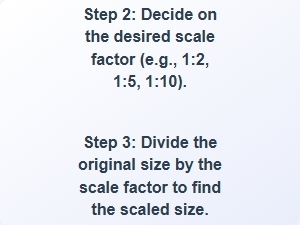
To calculate the scale factor, start by identifying two corresponding measurements one from the diagram and one from the real object. Divide the diagram measurement by the real measurement. The result is the scale factor. If the diagram is smaller, the scale factor will be less than 1. If it’s larger, the scale factor will be greater than 1.
For instance, if a model airplane wing is 10 inches long and the actual wing is 50 inches, divide 10 by 50. The scale factor is 0.2. This means the model is 1/5 the size of the real wing.
Common Mistakes to Avoid
A frequent error is mixing up the order of measurements. Always divide the diagram measurement by the real measurement, not the other way around. Another mistake is forgetting to convert units before calculating. If one measurement is in inches and the other in feet, convert them to the same unit first.
Some people also overlook the fact that scale factors can be expressed as ratios, like 1:10, or as decimals, like 0.1. Both mean the same thing. Make sure your final answer matches the format expected in your task or class.
Useful Tips for Accurate Calculations
Always double-check your measurements. A small error in one number can lead to a large mistake in the scale factor. Use a ruler or measuring tool to get precise values from diagrams. If the diagram is unclear, look for labels or notes that indicate the scale.
Practice with examples from worksheets or online tools. These exercises help reinforce how scale factors work in different scenarios. Keep track of your steps so you can review them later if needed.
Next Steps for Learning More
If you want to deepen your understanding, try applying scale factors to real-life projects. Measure objects around your home and create scaled drawings. Compare your results with others to see if you’re on the right track.
Explore more detailed guides on calculating scale factors and practice with additional problems. Understanding this concept opens the door to more advanced topics in geometry and design.
Checklist: - Identify corresponding measurements in the diagram and real object. - Convert units if necessary. - Divide diagram measurement by real measurement. - Check if the result makes sense based on the diagram. - Practice with examples to build confidence.
 Scale Factor Worksheet for Geometry Students
 Interpreting Scale Factor in Real World Examples
 How to Calculate Scale Factor Step by Step
 Understanding Scale Factor in Math Problems
 Scale Factor Examples for Students
 Scale Factor Worksheet Problems in Geometry